

What Is a Lean Canvas? A Practical Guide for Dubai Founders

Are you a founder who wants to test your idea reach? If so, you’re probably thinking about a business plan — a structured way to make the idea feel real. But a business plan is designed to present certainty. And at the idea stage, you don’t have certainty. You have assumptions.
The Lean Canvas was built for that gap.
What the Lean Canvas Is & What It Isn’t
The Lean Canvas is a one-page business model framework created by entrepreneur and author Ash Maurya, adapted from Alexander Osterwalder’s Business Model Canvas. It has nine blocks. Each one asks a specific question about your business. The whole thing fits on a single page.

That’s not a design conceit. It’s a deliberate constraint. The Lean Canvas isn’t meant to be finished; it’s meant to be iterated on. You fill it in with what you know, identify the assumptions you’re making, and then test the ones that matter most.
A business plan asks you to predict the future. A Lean Canvas asks you to surface what you don’t know yet.
For idea-stage founders — particularly those still employed full-time and not ready to make irreversible decisions — the Lean Canvas is the right starting point.
The Nine Blocks, in the Order That Matters
The Lean Canvas has a sequence built into it. The order is deliberate, and ignoring it is a common mistake first-time founders make.
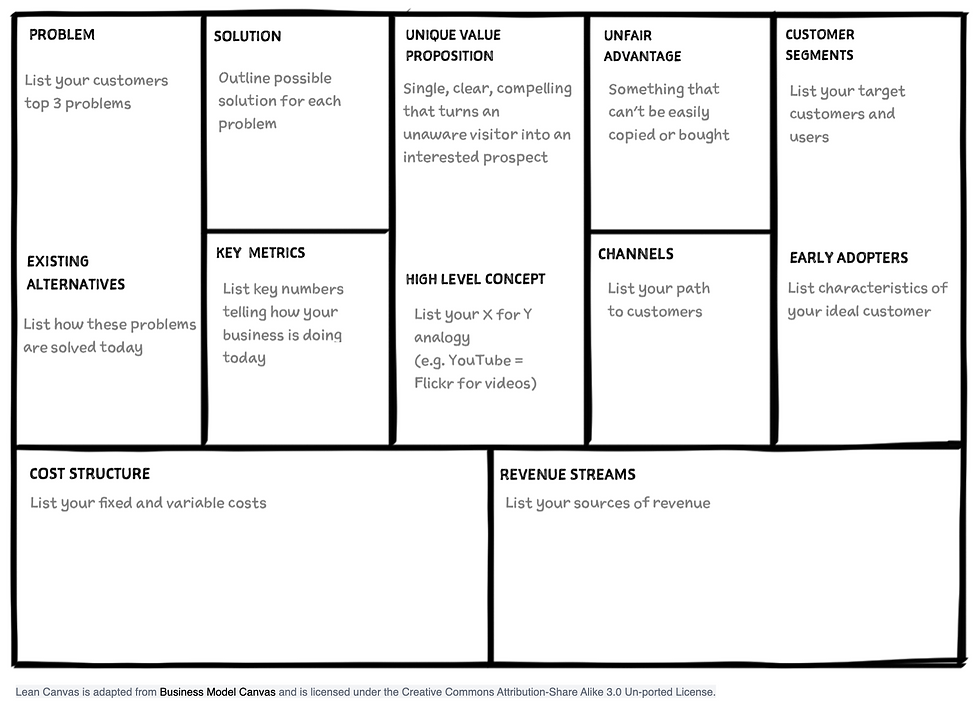
Problem
Start here. List the top one to three problems your potential customers are experiencing. Be specific. “People waste time” is not a problem. “Operations managers at restaurants in Dubai spend two hours a day manually reconciling reservation data across three systems” is a problem. The more specific your problem statement, the more testable it is.
Customer Segments
Who has the problem you just described? Be as precise as you can. Not “small businesses” but “independently owned restaurants with fewer than 50 seats in the UAE.” The tighter your customer personas at this stage, the faster you can get in front of real people and validate your assumptions.
Unique Value Proposition
The single, clear statement of what you offer and why it matters. It should speak directly to the problem above and be addressed to the customer segment you defined. If you can’t write this in one or two sentences, you probably haven’t defined the problem clearly enough yet.
Solution
Notice where this appears — fourth, not first. The Lean Canvas forces you to earn the right to propose a solution by working through the problem, the customer, and the value proposition first. This sequencing matters. Most founders write their solution in five minutes and spend the rest of their time defending it. The canvas asks you to wait. Describe your solution briefly. It will change. Write it lightly.
Channels
How will you reach your customers? This block is often underestimated at the idea stage, but it shapes everything from your cost structure to your pricing. A founder selling B2B in the UAE has very different channel considerations than one building a consumer app. Note what you currently know, and flag what you need to find out.
Revenue Streams
How will the business make money? List the primary revenue stream first, then any secondary sources. Be honest about what’s proven versus assumed. If you haven’t charged anyone yet, you haven’t validated your financial model.
Cost Structure
What does it cost to run this? Focus on the costs required to reach your first customers, not the costs of running a mature business. The gap between these two is where early-stage financial projections go wrong.
Key Metrics
What numbers will tell you whether the business is working? Choose one to three metrics that reflect real customer behavior, not vanity metrics like follower counts or website visits. Good early metrics: number of paying customers, repeat purchase rate, time to first transaction.
Unfair Advantage
This is the hardest block to fill at the idea stage, which is why it often gets left blank. An unfair advantage is something you have that competitors cannot easily copy: deep domain expertise, a specific network, proprietary data, or a distribution channel others don’t have access to. If you don’t have one yet, leave it blank and come back to it. Honesty here is more valuable than a convincing-sounding placeholder.
How to Use the Canvas
Fill it in on one page. Don’t treat it as a final document. The version you write today is a hypothesis — it will be wrong in at least two or three places, and that’s expected. The point is to make your assumptions visible so you can test them.
In the UAE context, pay particular attention to the Customer Segments and Channels blocks. The market here is specific: a large proportion of potential customers are expatriates with distinct spending behaviors, many businesses operate within the free zone structure, and the B2B sales cycle in the Gulf has particular conventions that affect your go-to-market approach and your timeline.
Revisit the canvas every two to four weeks as you learn more. Update what changed. A Lean Canvas that doesn’t change isn’t being used; it’s being filed.
How This Fits Into a Structured Validation Process
The Lean Canvas is a starting point, not a validation method. Filling it in gives you a map of what you know and what you’re assuming. What comes next is testing those assumptions, starting with the riskiest ones.
If you want a structured process for working through a Lean Canvas and testing the assumptions behind it, the IDEA Program is built around exactly this approach. 14 weeks. AED 3,000. Zero equity.


