

The Assumption I Was Most Afraid to Test & What Happened When I Did
The assumption I was most afraid to test was simple: do parents in the UAE actually care enough about AI safety to show up for it and pay from their pockets?
I knew, from the beginning, that Jeel AI lived or died on the answer to that question. If parents didn’t see AI as a real threat to their children — or worse, if they saw it as someone else’s problem — then nothing I built would matter. I had a product. I had research. I had a newsletter and a growing conviction that the problem was urgent as families were being left behind in the AI era. What I didn’t have was proof that anyone outside of my own head agreed with me.
So I didn’t look for it. Not really.
For about a month, I kept my validation comfortable. I sent out anonymous surveys. I did occasional one-on-one interviews — carefully scheduled, carefully controlled. I told myself this was methodical. What I was actually doing was making sure I could never get a clear answer. Anonymous surveys don’t look you in the eye. Scattered interviews let you choose who you talk to.
The specific thing I was afraid to find out was this: if I showed up publicly and no one came, that would mean the problem I believed in wasn’t one that UAE parents felt urgently enough to act on. And if that was true, everything would have to change.
So I stayed quiet and told myself I was being thorough.
The Room I Had Been Avoiding
What finally forced the test wasn’t a strategy. It was an invitation. The co-founder of AI Safety UAE had noticed what I was building. She was organizing an event under the UAE’s Year of Family 2026 banner and she asked me to speak. Not in the background. As a founder, in public, talking about my startup to a room of parents, caregivers, and teachers.
I had never publicly spoken in my life. Not outside of university presentations. I was going to stand in front of strangers with an MVP that was, at the time, essentially a newsletter and a landing page. No fully-built product. No case studies. No visible solution from the Jeel AI startup. Just a thesis about what families needed and a nervous conviction that I was right about it.
Fifty people showed up.
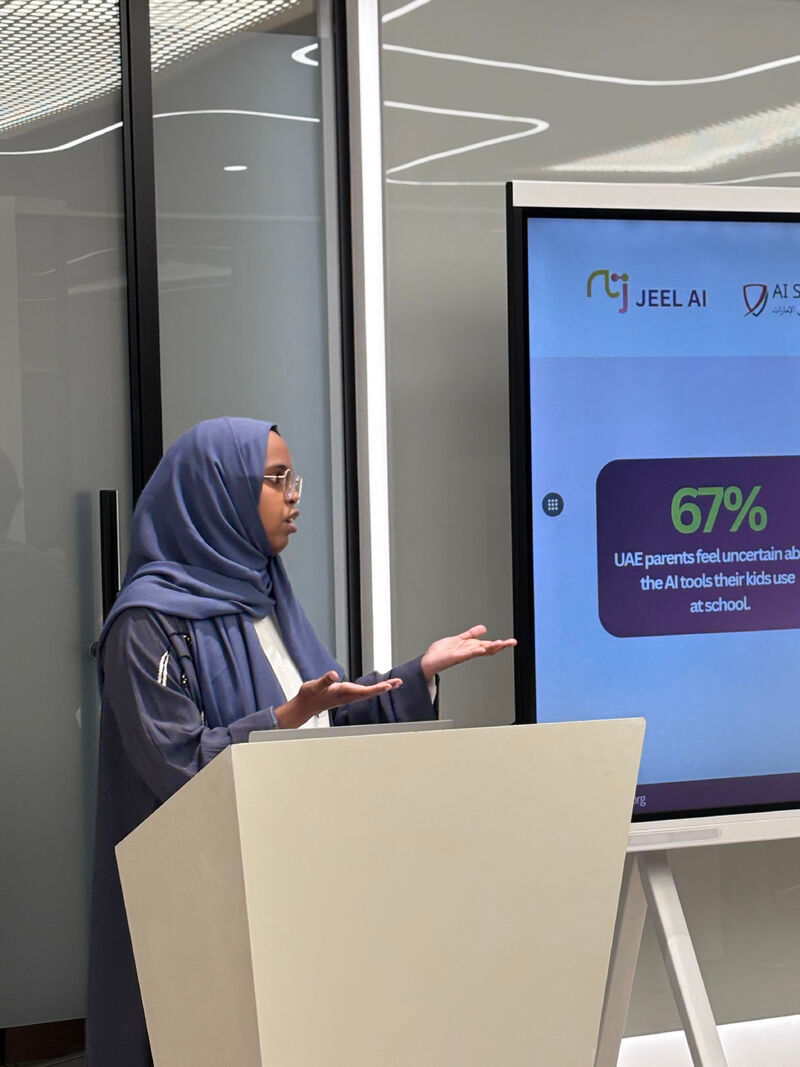
I don’t know what I had expected — maybe 15 people, or maybe polite nodding and a quiet exit. What I got was a room that was paying attention. And after I spoke, a teacher came to find me. She had a PhD in education. She said to me, “I feel helpless. No support at home for kids on AI dangers.” Then she asked me to come to her school to give a talk to parents and teachers alike on this topic.
That sentence did something to me that a month of surveys never had. Here was someone with more formal expertise in child development than I would ever have, telling me she had no tools for this. Not that the problem didn’t exist; just that she was stuck inside it and couldn’t find her way out or who to go to.
“You don’t need to feel ready. I wasn’t.”
What Being Right Actually Revealed
The assumption was right, but being right revealed something I hadn’t expected. The demand was there. What I had gotten wrong was the channel. I had been building toward parents as direct consumers, expecting them to find Jeel AI, pay for it, and bring it into their homes individually. What that room showed me was that parents are often waiting for someone with authority — a school, an institution, a government program — to bring this conversation to them first. They weren’t uninterested. They were unequipped, and they were waiting for a structure that made it safe and easy to engage.
That single conversation with the teacher changed my business model. Not the mission but the mechanism. Jeel AI is now built around institutions: schools that deploy it to parent communities, companies that offer it as a family benefit, government programs that reach families at scale. The parent is still the person we are ultimately serving. But the institution is what gets us to them.
I spent a month protecting an assumption that, when I finally tested it, turned out to be more complicated and more useful than I had allowed myself to find out.
Here is what I want to say to you directly: you already know which assumption you are protecting. You probably know exactly what you might find if you tested it, and that is exactly why you haven’t. But the test is not going to confirm your worst fear and leave you there. It is going to tell you something true. And that truth, even if it changes things, will make everything you build from that point forward more solid than what you are standing on right now.
You don’t need to feel ready. I wasn’t. Stop interviewing carefully selected people in controlled conditions and building around your fear. Find the room you’ve been avoiding. Test it. And go.
Fatma Egal is the founder of Jeel.ai. With a background in AI and marketing, she is building a safety layer between UAE families and the new AI era. Fatma is a Cohort 2 alum of the FRWRDx IDEA Program.
Fatma built Jeel AI inside the FRWRDx IDEA Program. Rolling cohort applications are open. 14 weeks, 7 milestones, AED 3,000 — and you keep your company.


