

How I Decided What My First Build Would Be (& What I Left Out)
- Divya Rai

- Jul 9
- 4 min read
What is ASWRA? A smart wellness ring that monitors your biometrics continuously and alerts the people who love you before something becomes an emergency.
That’s what it is now. But getting here took five completely different versions of the product. Not iterations. Versions. Each one was a different idea entirely, and each one failed for a different reason.
The honest thing to say is: I kept building before I had asked the right questions. I did not know that was what I was doing. But it was.
The First Ring
The first version had nothing to do with health technology. It was a ring with five petals, representing the five fingers in the universal hand sign for “I need help” used in domestic violence awareness campaigns.
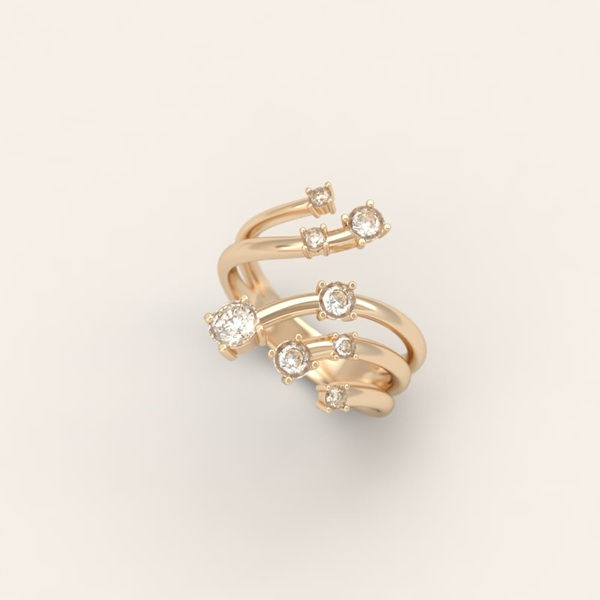
The model was simple: sell the ring, give 50% of profits to NGOs working on women’s safety. I had watched another founder build something similar — a cause-driven jewelry brand that got celebrity adoption, enormous press, and a waiting list. The model worked for her because her story was airtight and her team had the doors that made it spread. I wanted to build something with that same clarity of purpose.
So I designed it. Priced it. Mapped the giving structure.
What I did not do: look at the market I was walking into.
Jewelry with a cause is a name-driven category. Without an established brand or the right network behind you, a beautiful ring with a beautiful story is still just a ring. I had not asked whether I had an unfair advantage here before I started designing for it. I didn’t.
The Thorn
So I tried to make the ring do more than say something. I explored embedding a hidden thorn beneath a screw-set stone so it could function as a self-defense tool if the wearer needed it.
I got mid-design before I stopped and actually asked what this meant.
A hidden thorn shifts the responsibility for safety back onto the person already in danger. It asks her to fight rather than be protected. That wasn’t the product I wanted to build. The entire premise had been women’s safety. A weapon hidden in a ring was not that.
I cut it. But I should have asked that question before I started. Not after.
The SOS Button
From there, I looked at SOS jewelry necklaces and rings with a panic button.
This time, I did ask the question, but only after I had already started scoping the product.
The problem was obvious once I pictured the moment: by the time someone is calm enough to press a button, they are often already deep in the emergency. The button works only if the wearer can still act for herself. That is not solving the hard part.
The Apple Watch
Biometric tracking felt like the natural next step. The hardware was mature. The SDKs existed. Smartwatches seemed like the obvious starting point.
That year, I got an Apple Watch as a birthday gift. I wore it every day.
It is a genuinely great product. It is also large, not particularly wearable for most women, and it needed charging every two to three days. I was not the customer for it. Neither were the women I was building for.
People stop wearing things that ask that much of them.
We pivoted to a ring. No screen. No daily charging. Something light enough to forget you’re wearing it, which is exactly what you need from a device that is supposed to be watching when you can’t.
The Question I Had Never Asked
That decision — ring, continuous biometrics, no screen — was the first one I made the right way around. I started with the wearer’s life, not the technology.
Then my friend died of a cardiac event at 27.
And the question I had never properly asked became impossible to ignore: who is this actually for?

I had been building for the wearer. But the wearer is almost never the one who is most afraid. It’s everyone around her — the people who would do anything to know five minutes earlier that something was wrong.
That realization is what ASWRA is built on now. Continuous biometric monitoring that tells the person who loves you when something looks off, before you would even know to ask for help yourself.
The mission didn’t change. I just finally asked the right question about who the product was actually serving.
Start With the Questions, Not the Product
When I went through the FRWRDx IDEA Program, the First Build milestone asked us to prepare and build the first version of our product and be ready to start promoting it.
That sounds straightforward. It isn’t. Because to build the right first version, you have to know what you are actually trying to prove and who you are proving it for.
I had skipped that question five times. Each version taught me something. None of them were wasted. But none of them were efficient either.
What I’d Tell a Founder Making This Decision Right Now
Start with the questions. Not the product.
Before you design anything, ask:
Who is this for, really, and are they the person I’ve been picturing?
What is the specific moment I am trying to change?
Am I the right person to win in this category, or am I copying a playbook that only works with advantages I don’t have?
The build comes after. Every version I left behind — the petal ring, the thorn, the panic button, the smartwatch concept — cost me time, money, and things I’d already commissioned. I don’t regret any of it, because each cut sharpened the question. But I could have asked the questions first.
Getting the order wrong is expensive. And it is the easiest mistake to make when you care deeply about what you’re building.
Divya Rai is the Founder & CEO of ASWRA, a smart ring that monitors biometrics continuously and alerts loved ones before a health emergency. She is a FRWRDx IDEA Program alumna.
If you are at the idea stage and want a structured process for making the right scoping decisions before you build, the FRWRDx IDEA Program gives you the framework and the mentor support to do it. 14 weeks, 7 milestones, AED 3,000, zero equity.


